
The Knowwood Tree

Origins
‘Knowwood Trees have a regretful origin’ is a statement made by those that forget these great locks, nay, protectors, were once formidable, living trees. They live still, but some time ago, long before the axe, they thrived, blooming in beauty and soaring to the sun. They lived for themselves, entirely. Now, they choose what to live for.
The first time a Knowwood Tree made this choice and earned its name, it went by another: an Answer Trunk. Determiners appointed by the corrupt power (or ‘government’) used these Answer Trunks - hollow logs of many species (oak, elm, ash, hawthorn et cetera) - to sacrifice all those suspect women many moons ago. The story is one you will be familiar with; they would lock her inside the trunk, and the water would swallow innocence or spit out witch.
Determiners got so exceptionally good at their craft that the role became the best paid and most respected in the village. They learnt to carefully select trunks and axemen and, for a hefty bag of gold, would allow your wife, sister, or daughter to calmly ride out their trial in a light five-footer, rather than a twenty-foot burdensome trunk. Determiners would do the opposite too; they’d take gold to guarantee disappearances. Poor women were used to settle debts; a small fee to sink the wife and ruin the family’s life. But the bark, you see, began to form opinions.
There was a testy period where neither onlookers nor analysts could see a pattern to the results of the witch trials, and both rightly concluded that there must have been an internal Answer Trunk debate playing out. To the Determiner’s confusion (and impending debt), women sank and died in weightless trunks while others floated in weighty trunks (that the Determiner then prised open ready for the flogging). The Determiner could no longer predict or fix the outcome. Then came the ‘Great Sinking Period of the Middle Meanderway’ where the world’s newspaper (as the editors term it), the Meanderway Miracle, reported that a woman sank at an average of every five minutes - and that wasn’t the most shocking statistic. Startlingly, one hundred percent of these sunken women survived the whole ordeal. Why? Well, they cannot all have been witches.
Theories amassed. The trunks were diseased and axemen should take the timber from other forests. The women were practicing their underwater breath holding and Determiners should submerge the trunks for longer. The women were making and sharing potions and the men in charge of the households should prevent them from leaving, conniving, and concocting. But with all these special measures in place, it continued to prove impossible to trial these women, to kill these witches.
Here are a handful of cases taken from Reveria’s Record of the Great Sinking Period of 1599:
Failed Answer DoR Trunk Incidents as reported by the Determiner
Etta Dorcasea – submerged in an 8-foot elm trunk for three nights – torn from the trunk dry, breathing, and vengeful.
Inga Perilsmith – submerged in a 17-foot oak trunk for 5 nights – found in her home after neighbours complained about the oak trunk protruding from her chimney.
Annie Beluahbun – submerged in a 12-foot elm trunk for one full week – found on day eight alive, well, and conversing with a cat.
Thea Thunderson – submerged in a great, convoluted, split branch of redwood tree of unmeasurable size for exactly 666 hours – found in a bivouac 200-foot up a robust and untouched redwood.
Rea Allwater – submerged in a 20-foot willow trunk for 10 to 20 days (the length of time is uncertain on account of the Fortnight of the Twenty Determiners) – found at the town centre stealing yarn that she attested was necessary to knit head-warming hats.
Ursula Russelgrip – submerged in a 4-foot ash trunk for a full lunar cycle – found to be unpresent once the log was sawn open (at an undetermined time due to the Fortnight of the Twenty Determiners) – confirmed alive and well through letter correspondence to every resident of the village.
Velma Ritestench – submerged in a 27-foot cherry blossom trunk for 27 days – found arranging feathers suspiciously in the dirt and known to be behind the terrifying 27 wrongs I demand you make right (warnings in the form of animal bones and voodoo dolls posted through many current and former Determiners’ doors).
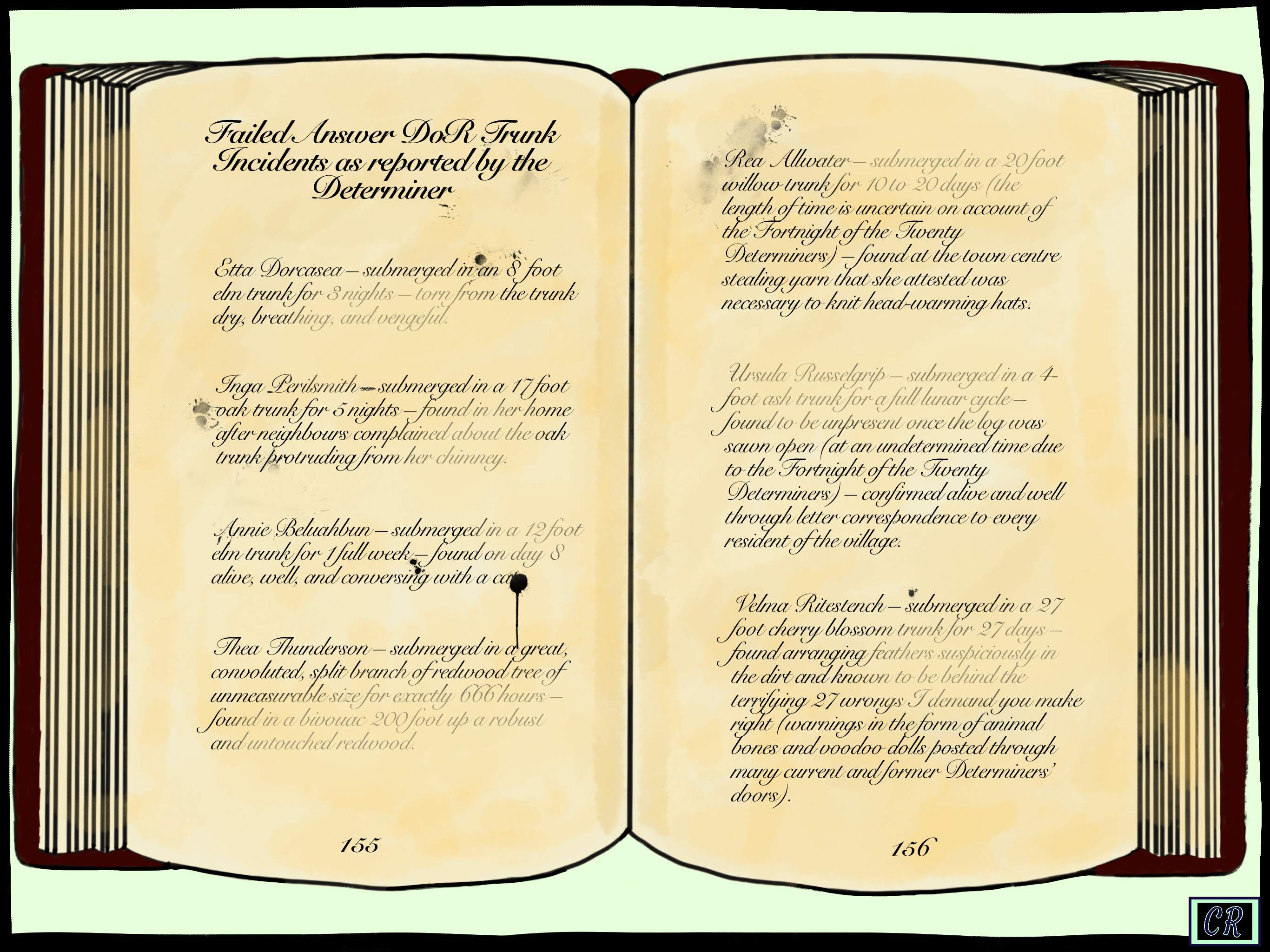
A double spread page taken from Reveria’s Record of the Great Sinking Period of 1599.
NB: DoR stands for Deserter of Reveria (in the equivalent way that the term DoN, Deserter of Nabernook, used to refer to witches from Naberbook) and not Deliverer of Redemption, the slogan taken up by the pro-witches’ movement.

Evolution
How do we get from protecting witches to keeping stories? Well, no one is sure, though the fact that Knowwood Trees are often found in groups (with the collective noun: a privy of Knowwood Trees) suggests a natural evolution, rather than an artificial or magical meddling. Frequently, one can find privys in numbers of between ten and fifty, surrounded by ‘ordinary woodland’ (if you believe in such a claim – forests are incredible places).
Many old thinkers have hypothesised that all Knowwood Trees share a common ancestor, and all trace this back to Inga Perilsmith’s oak trunk. The story goes that this tree, which moved against evil by protecting Inga in the witch trials, dropped thousands of astute acorns year after year for five centuries, and Navarre crows carried these sagacious seeds on their travels, dropping and planting the Knowwood acorns across the Meanderway. Therefore, on closer thought, it doesn’t appear that the privys have sprung up randomly. A ploy in play?
What each Knowwood Tree houses is knowledge only to the tree and its chosen Keeper. Every tree is an individual, in the same way that every person is an individual. This means that one will have different preferences to its neighbour, but both will have different allegiances to a privy resting on the opposite side of the Meanderway, where, incidentally, folk from the north refer to the trees as Sausors (from the Latin for advocate).
Knowwoods have protected people other than witches too. The trees listen through wise roots and present themselves to a Keeper once they have selected a cause and chosen a side (refer to Inga Perilsmith’s private diary of 1601). Evidence of this litters like all the colours of autumn in the Islands of Vereterra’s largest woodland, Freeforest – where witches weirdly have no history. In the Early Wars of the Meanderway, great oak trees opened like cupboards to hide soldiers of the homeland they shared. Then the trees grew ladders and lookout holes and offered more than defence, they offered a strategic advantage. Past generations of Vereterrans still call the privy Our Wise Armoury. Sadly, today’s Vereterrans call it the Green Graveyard.
Why my own Knowwood Tree chose me is a question that stops me dropping off to sleep. I fill its sturdy shelves with my take on the world around me. Perhaps it’s what I am yet to write about, what I am yet to discover, that it sees worthy of protecting.


Next up in Fantasy Friday:
Visit Vereterra: The Green Graveyard
Interested in learning more?
